
Screen-Free Learning · Original family activities
7 Screen-Free Halloween Activities With Paper and Pencils
Try seven easy Halloween activities with paper and pencils: pumpkin portraits, funny monsters, mazes, comics, and family storytelling. No printer needed.
By James Teen · October 13, 2026
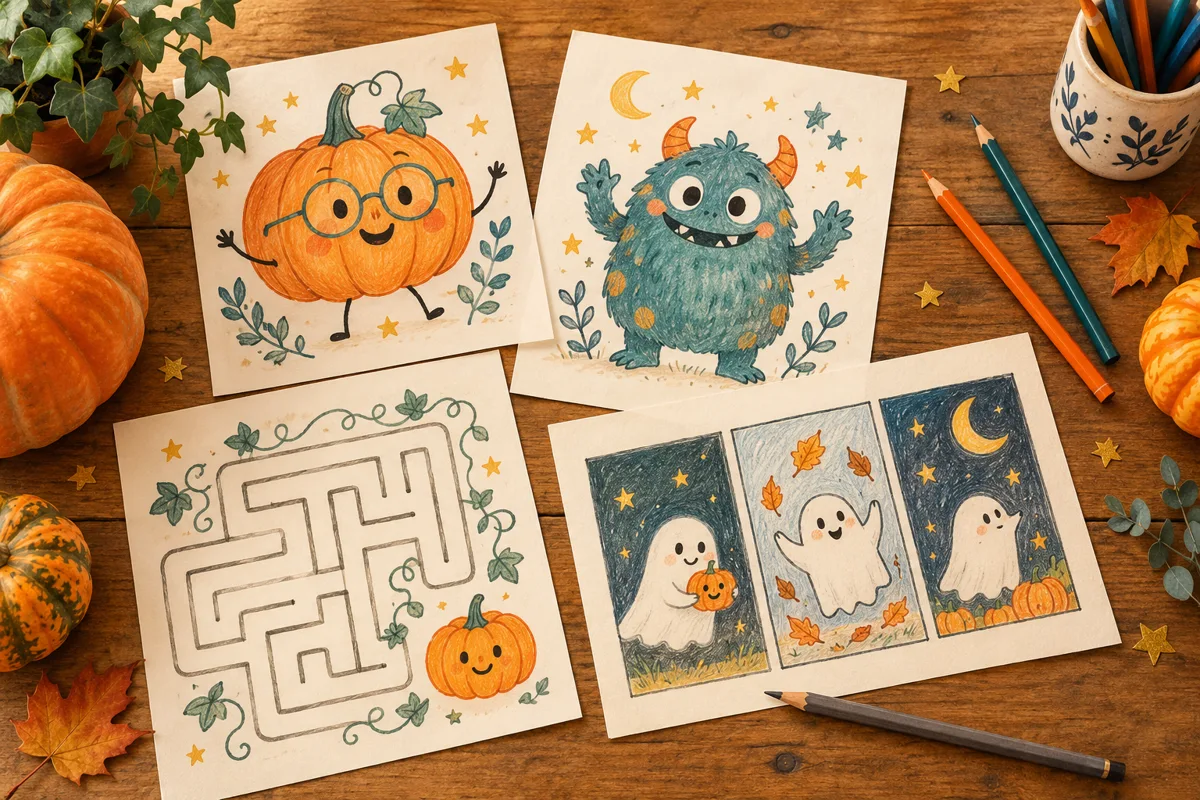
A quiet October afternoon does not need a craft-store trip. A few sheets of paper and ordinary pencils can become a pumpkin gallery, a monster workshop, or a tiny Halloween comic.
Choose one activity below, rather than treating the list as seven jobs to finish. Most can begin with a few marks and continue for as long as everyone is interested. These are original James Teen blog activities, not pages from a book or downloadable pack.
What you need
- Plain paper, including clean scrap paper
- A pencil for each person who wants to draw
- Colored pencils or crayons, if you already have them
No printer, scissors, glue, decorations, or screens are needed. A grown-up can do the writing while a child draws or tells the story aloud. Keep the theme as silly, cozy, or spooky as your child prefers; pumpkins and autumn leaves work if ghosts are not welcome.
1. Give a pumpkin a completely new personality
Draw a large oval with a small stem. Add a face, then choose one unexpected detail: enormous glasses, roller skates, a tiny backpack, or a hat that is bigger than the pumpkin.
Ask, “What is this pumpkin getting ready to do?” Perhaps it is a librarian who keeps losing its glasses or a dancer practicing for a party. Let the picture suggest the story instead of deciding what a pumpkin should look like.
Make it easier: Draw the oval yourself and let your child choose or add the details. Try another round: Draw the same character feeling sleepy, surprised, and excited, then invent a reason for each expression.
2. Design a friendly monster with a very ordinary problem
Each person chooses three details: a body shape, an unusual feature, and a favorite everyday thing. A triangular monster might have springy feet and love pancakes. A round monster might have five ears and collect mismatched socks.
Give the creature a small problem to solve: its shoes do not fit, it cannot reach the cookie jar, or it has forgotten a friend’s name. Draw one possible solution and give the monster a name if you like.
Make it easier: Offer two shapes to choose from. For a child who enjoys writing: Add a short speech bubble. This is an imaginary drawing game; nobody has to act out the monster’s problem.
3. Draw a pumpkin-patch maze for each other
Put a small pumpkin near one corner of the page and draw a basket near another. First draw a light pencil route between them, leaving room around it. Add two walls alongside that route, keeping a clear entrance and exit. Then add a few branching paths that end before reaching the basket.
Erase the original route if you want a puzzle, or leave it visible as a path to trace. Test the maze yourself before swapping pages: can a pencil line reach the basket without crossing a wall?
Make it easier: Use a broad winding path without dead ends. Try another round: Put a friendly scarecrow beside one wrong turn. Avoid making the passages so narrow that drawing through them becomes the whole challenge.
4. Tell a Halloween story in three boxes
Draw three large rectangles across a sheet. In the first, introduce a character who wants something. In the second, add a small mix-up. In the third, show what happens next.
For example: a ghost wants to bring a pumpkin to a party; it reaches the wrong house; a neighbor points it toward the party next door. Your child can change any part of the example or invent a completely different story.
Pictures alone count. You can write a sentence your child dictates under each box, or add speech bubbles only if they want them. An unfinished third box is fine; the ending can wait.
5. Make a mystery Halloween picture with three clues
Choose something simple to draw without showing the page: a pumpkin, a broom, a cat, or an autumn leaf. Give three clues, one at a time, while the other person sketches a guess.
For a pumpkin, you might say, “It grows on a vine,” “It can be round,” and “It has a stem.” After the third clue, reveal the original picture and compare your ideas. The point is the conversation, so there is no need to keep score.
Make it easier: Agree on two possible answers before starting. Try another round: Reverse the roles and let your child give the clues. Different drawings of the same object are welcome.
6. Turn an ordinary room into a pretend Halloween map
Draw a simple outline of a room you know. Add a doorway, a table, and a chair, then imagine that they have new names: the table is Pumpkin Plaza, the chair is Cat Lookout, and the doorway is the Gate of Giggles.
Choose a starting point and a destination. Draw a route between them and tell a tiny adventure: “Our visitor stops at Pumpkin Plaza to ask for directions, then reaches Cat Lookout.” Everything can happen on the paper; no hiding objects or climbing around the real room is needed.
Make it easier: Use three landmarks instead of a whole room. For a bigger story: Add one place where the visitor can ask for help.
7. Create a costume for a character on paper
Draw a stick figure, an animal, or one of your earlier characters. Invent a costume that would be impractical but funny: a cloud wearing rain boots, a book with wings, or a pumpkin dressed as a pineapple.
Add one detail that explains how the costume works. Where would the wings go? What would the character carry? You can sketch several ideas on the same page without choosing a winner.
Finish by asking, “What would this character say when someone guessed the costume?” Say the answer aloud or add a speech bubble. This stays a drawing activity—there is no costume to buy or make afterward.
What if your child says, “I don’t know what to draw”?
Offer a small choice: “Pumpkin or cat?” or “Should we start with a circle or a zigzag?” Make a mark on your own page and invite them to change it. You can also draw while your child gives directions.
If neither choice sounds interesting, put the paper aside. A Halloween activity does not have to become a finished project. For a different starting point, try our story hunt with five everyday objects. For a shared page, the back-and-forth drawing game offers a separate activity.
Choose a simple ending
Ask each other to point out one detail they enjoyed making. Give the page a title, keep it in a folder, or recycle it together. Ask before photographing or sharing your child’s work. There is no need to turn every drawing into a keepsake.