Family Connection · A family activity
The Back-and-Forth Drawing Game: One Page, Two Imaginations
Share one sheet of paper and take turns adding to a drawing. A simple family activity with no scores, perfect pictures, or special supplies required.
By James Teen · September 28, 2026
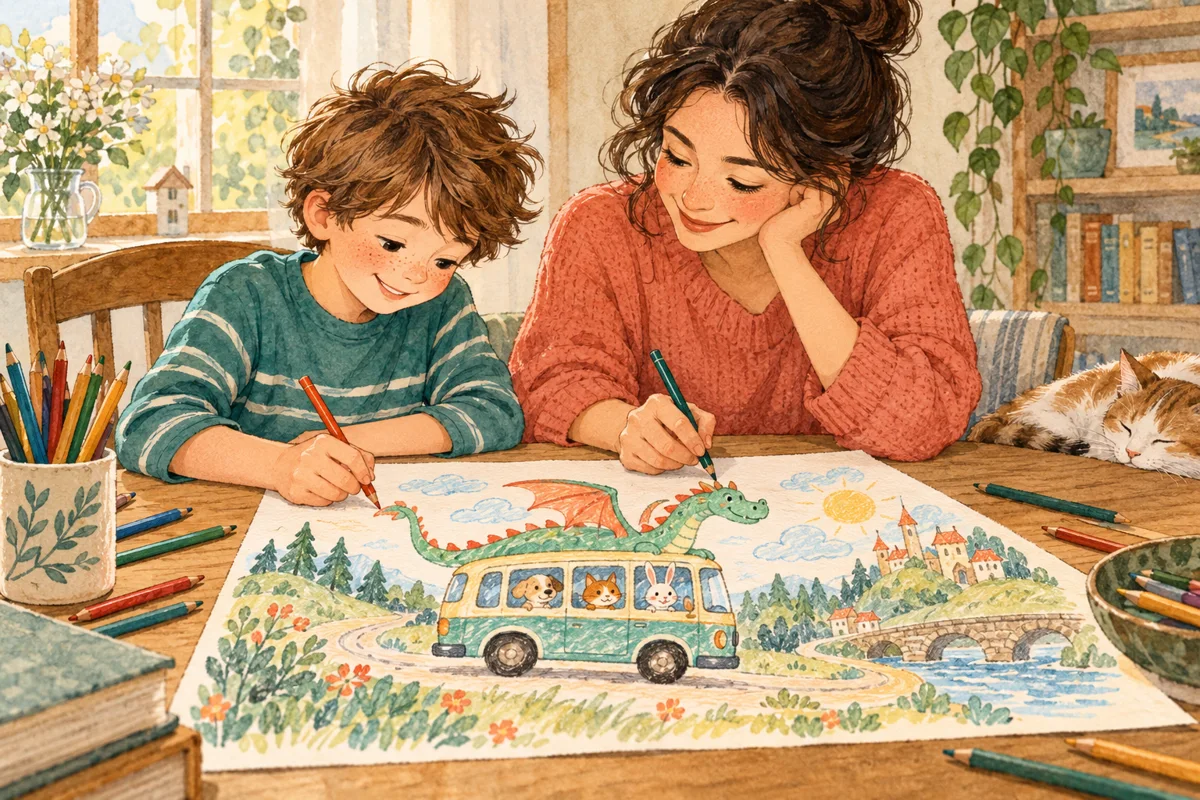
What happens when one person draws a doorway and the other adds a dragon peeking through it? You have the beginning of a picture neither of you planned alone.
This back-and-forth drawing game gives a child and a grown-up one page to build together. Set aside about ten minutes, or stop after a few turns. There are no scores and no finished picture to copy. The instructions below are an original activity for the James Teen blog, not a sample from one of our books.
What you need
- One sheet of paper placed where both of you can reach it.
- A pencil, crayons, or other age-appropriate drawing tools.
- A comfortable space for two people.
Play with a parent, grandparent, caregiver, or another trusted grown-up. If sharing one page feels frustrating, begin with two pages and pass them back and forth only if both players want to.
1. Agree on two simple rules
Take turns adding one thing. Leave the other person’s marks in place unless they say you can change them.
“One thing” can be a tiny dot, a person, a cloud, or a whole wobbly tree. You do not need equal drawing skills or equal-sized turns. If your child wants you to draw something for them, follow their directions and hand the choice back when they are ready.
2. Begin with a shape
Let your child make the first mark, or offer to start with a circle, a zigzag, or a rectangle. Ask, “What could this become?” You might both have different answers. Choose one together, combine them, or leave the question open for another turn.
A rectangle might become a bus. On the next turn, someone adds wheels. Then come passengers: a cat, a robot, and a tired-looking cupcake. There is no need to make the scene realistic.
3. Add, notice, and pass
After each turn, pass the paper or move your hand away to make room. Describe something you notice: “Your robot has a very small suitcase.” Try a curious question if your child seems interested: “What’s inside it?”
Leave room for quiet drawing too. You do not have to narrate every mark. Avoid redrawing a child’s line to make it neater; the uneven windows and sideways wheels belong in this picture.
4. Let a disagreement become a choice
Perhaps you want an ocean and your child wants outer space. Offer a few possibilities: a space ocean, two parts of the page, or saving one idea for another drawing. Let your child suggest something else.
If a mark covers someone else’s work by accident, pause. Ask whether to keep it, add something around it, or start a fresh page. The point is to decide together, not to protect a perfect result.
5. Give the picture a title
When either player is ready to finish, take one last look. Each of you can suggest a title, or you can combine two: “The Cupcake Bus Visits the Moon.” Write it down if you both want to.
Ask, “Which part surprised you?” or “What would happen next?” One answer is enough. Your child can also choose to leave the picture untitled.
Three ways to play again
- The impossible house: add one room at a time. What is a room just for clouds like?
- A memory map: take turns drawing details from a day you spent together. Different memories can share the page.
- The creature workshop: one person draws a body, the other adds a way to move, then you invent its home.
Ask before displaying or photographing the drawing. Keeping it in a folder, giving it to each other, or recycling it are all possible endings. The time you spent making it does not depend on keeping the page forever.
More drawing time together
If your family enjoys a book to draw in, explore James Teen’s Draw With Mom or Draw With Grandma. Today’s game works with ordinary paper; no purchase is needed to play.