Screen-Free Learning · A family activity
Turn Five Everyday Objects Into a Screen-Free Story Hunt
Gather five familiar objects and invent a story together. Try this screen-free activity with speaking, drawing, or writing options for different ages.
By James Teen · September 28, 2026
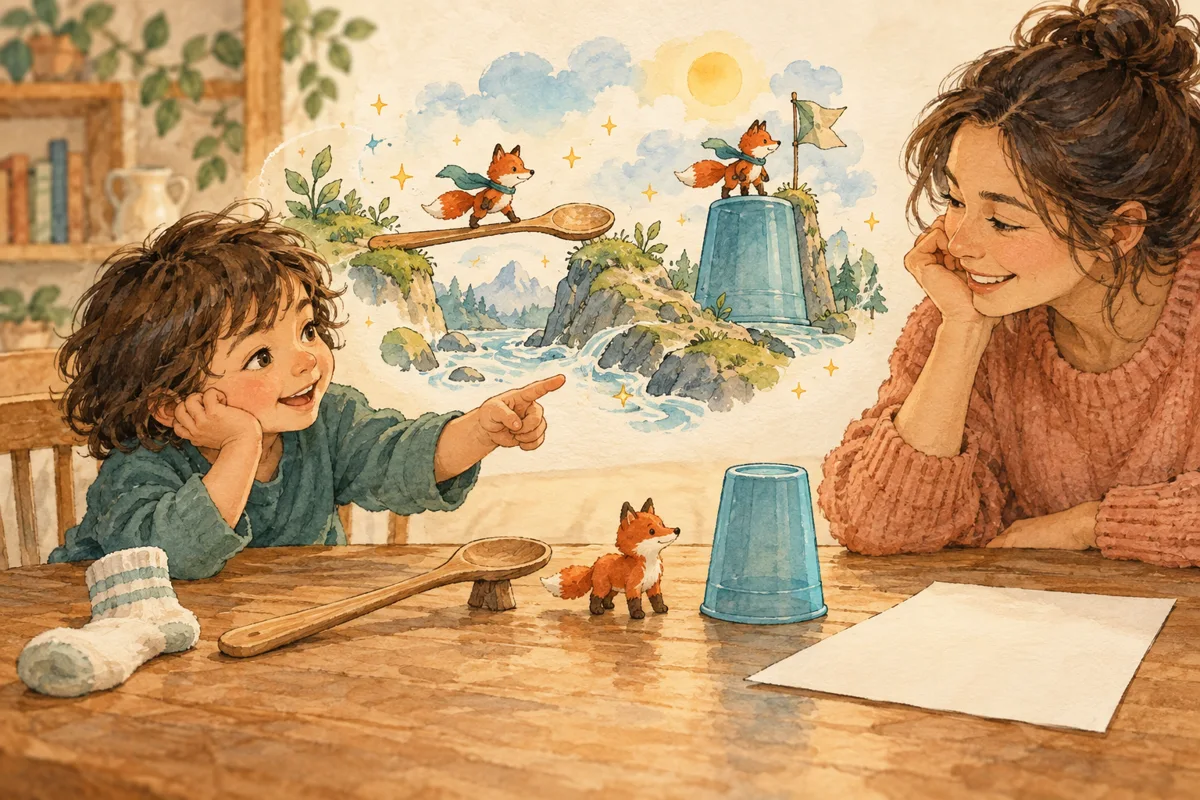
A sock, a wooden spoon, and a toy animal do not look like a story. Not yet. Add a character with a problem, and suddenly the spoon is a bridge and the sock is a sleeping bag for a very small explorer.
This screen-free story hunt turns familiar objects into a make-believe adventure. Allow about fifteen minutes, including gathering time, and adjust the pace to your child. It is an original James Teen activity you can try with things you already own.
Set up a small search area
Choose one room or a single table. Invite your child to find five safe, easy-to-handle objects they are allowed to use. You might offer a clean sock, a wooden spoon, a large toy animal, a plastic cup, and a sheet of paper.
Set the boundaries before the hunt: no climbing, no opening private drawers, and no breakable, sharp, or tiny items. For younger children, let a grown-up gather the objects and invite the child to choose from that selection. Searching is optional; the whole game can happen at the table.
1. Choose your main character
Spread the objects out and ask, “Who is our story about?” A toy animal is an obvious choice, but the sock could also be a character. Give it a name if that sounds fun.
Begin with one sentence: “This is Pip, a fox who wants to find a quiet place to sleep.” Your child might choose a different goal: finding a lost hat, bringing a gift to a friend, or getting home before dinner. Keep the goal small enough to remember.
2. Give one object a new job
Pick another item and imagine a different use for it. The spoon can be a bridge, the paper a map, and the cup a tower. Ask your child what they see before offering your own idea.
You can act out the story without pretending the objects are real tools. A spoon bridge only needs to carry an imaginary fox; nobody needs to stand on furniture to cross it.
3. Add one manageable problem
Try, “Pip reaches the bridge, but something is in the way. What is it?” Maybe the bridge has a missing plank or a sleepy giant is blocking the path.
If your child gets stuck, offer two possibilities and let them invent a third. Keep the problem as silly or gentle as they prefer. There is no requirement for a villain, danger, or a surprise ending.
4. Find a solution together
Invite your child to use another object to help. Pip might turn the paper into a pretend boat or ask the giant for directions. Take turns adding one sentence, or let your child tell the whole adventure while you move the props.
Try to follow the story’s own rules. If you agreed the cup is a tower, ask before turning it into a rocket. Changing a detail together is part of the game; correcting every unusual idea is not.
5. Tell the beginning, middle, and end
When the character reaches the goal, line up three objects as reminders. Ask, “Where did we start? What got in the way? How did it end?” You can answer together.
For Pip, that might be: the fox wanted somewhere quiet; the bridge was blocked; a friendly giant showed Pip another path. Your version can be longer, shorter, or completely different.
Choose how to keep your story
- Tell it: perform it once more for a willing family member, or just for each other.
- Draw it: divide a page into three spaces and draw a moment in each.
- Write it: let your child dictate while you write, or invite an interested writer to add a sentence under each picture.
Writing is optional. If your child wants another round, swap one object and keep the others. If they have had enough, put the objects away together. An unfinished adventure can wait.
Keep exploring without a screen
For another activity with household objects, try our pretend store money game. For a quieter shared page, play the back-and-forth drawing game.
You can also browse James Teen’s books for more drawing and family activity ideas. Today’s story hunt needs only your objects and imagination.