
Family Connection · Drawing and storytelling
Draw a Memory Together: A Grandparent–Child Activity
Turn a family memory into a drawing with simple prompts, a step-by-step activity, and ideas for grandparents and children who live far apart.
By James Teen
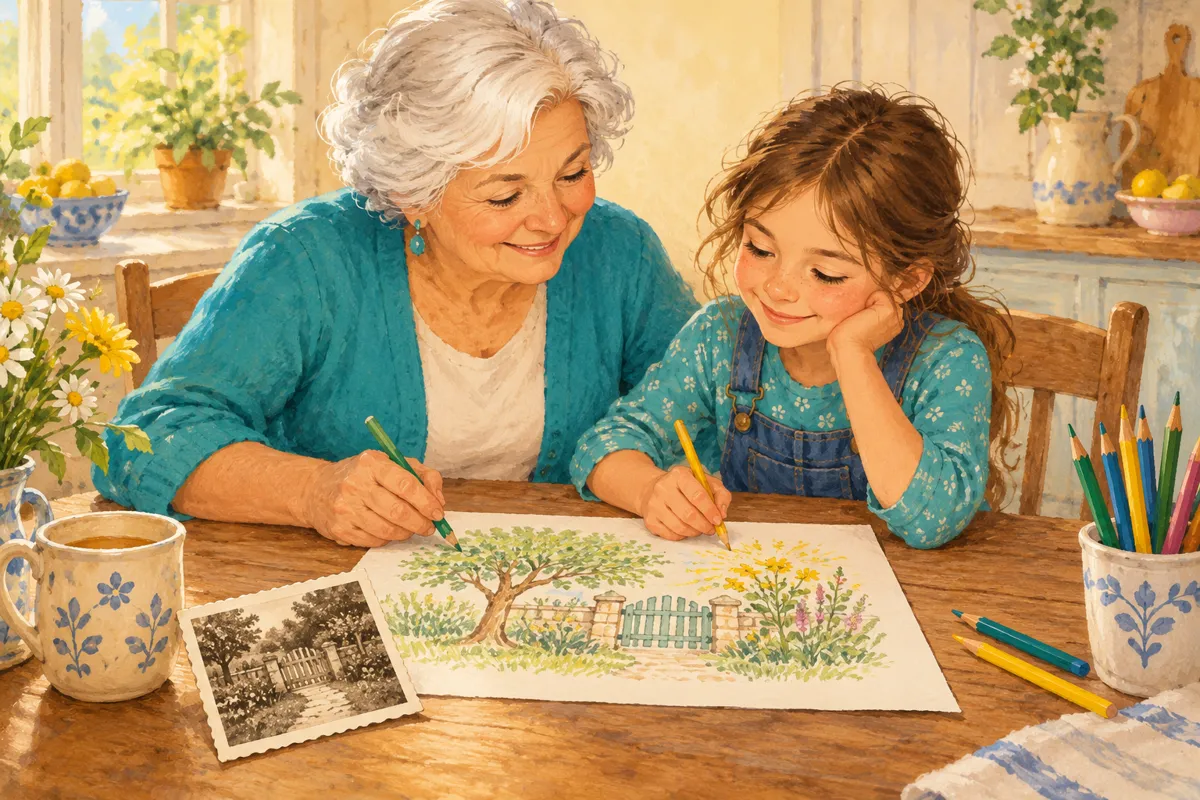
“What did your backyard look like when you were little?” A question like that can become a gate, a crooked tree, and a story about where someone used to play.
This grandparent–child drawing activity begins with one small memory. One person tells, the other asks and draws, and both decide what belongs on the page. You do not need an interesting family heirloom, an artistic grandparent, or a child who loves writing.
The activity below is an original idea for the James Teen blog, not a sample from a book. Ordinary paper is all you need. Try it with a grandparent, another older relative, or a trusted grown-up who wants to share a story.
What you need
- A sheet of paper and pencils or crayons.
- A comfortable place to talk and draw.
- Optional: a photograph or familiar object to help choose a memory.
Set aside about 15 minutes as a starting point, and stop sooner or continue longer if you both want to. There is no required number of details to include.
1. Choose a small, comfortable memory
Ask the grown-up to choose something they are happy to remember: a place they played, an ordinary meal, a pet, or a day spent with someone they liked. “Tell me your whole life story” is a big request. “What was near your front door?” gives you a place to start.
Offer two options if choosing feels difficult: “Would you like to draw your old kitchen or somewhere you played outside?” Passing, choosing a recent memory, or switching to an imaginary place are all fine.
2. Listen for three things you can draw
Let the storyteller begin without interrupting to collect every date or name. After a short part of the story, ask about one detail at a time.
- What could you see from where you were sitting?
- What object do you remember using?
- Who else was there, if you want to include them?
- What small thing would help me picture that place?
For example, a grandparent might describe a kitchen with a round table, a blue bowl, and a dog waiting by the door. Those three details are enough to begin. The child can choose which one to draw first.
3. Build the picture together
Start with simple shapes. A rectangle can stand for a house, a circle for a table, and a few marks for a tree. Let the child ask for details as they go: “Was the gate next to the tree?”
The grown-up can draw too, describe while the child draws, or ask the child to direct the pencil. If sharing a page is frustrating, use separate sheets and place them side by side.
Avoid fixing the picture to make it look more realistic. You can say, “I remember the window being here—shall we add it?” and let the child decide how to fit it in. If no one remembers a detail, leave it blank or label it “not sure.” This is a drawing of a remembered story, not a test.
4. Add one sentence in the storyteller’s words
Ask, “What would you like us to write about this picture?” A child who enjoys writing can add the sentence; otherwise, a grown-up can write it down and read it back.
A possible caption is: “We sat under this tree when the afternoon was hot.” Add the storyteller’s name and the date you made the drawing if they want. You do not need an exact date for the memory itself.
You can also include a question the child still has. “What did the dog’s bowl look like?” leaves a starting point for another conversation.
5. Let the child share a memory too
Give the child a turn as storyteller: “Would you like to tell me about a place you enjoy?” They might choose a playground, a friend’s porch, or a corner of the living room.
The grandparent can draw from the description, or they can make a second picture together. Notice one similarity or difference without deciding whose childhood was better: “You both remember a place to sit outside.”
A five-minute version for a short visit
- Choose one object from a memory, such as a lunchbox, bicycle, or favorite cup.
- Draw that one object together.
- Ask one question: “What did you do with it?”
- Write down one sentence, then stop if that feels like enough.
A page with one object and one sentence is a finished activity. You do not need to turn it into a larger project.
How to do it when you live far apart
On a phone or video call, the grandparent can describe a place while the child draws on paper. Pause after each detail. At the end, the child can describe the drawing or hold it up to the camera.
For an offline version, mail a simple prompt and a blank sheet. Invite the grandparent to send back a sketch or a few sentences; the child can add a drawing and return a copy. Keep originals only where their owner wants them.
If recording a conversation would be useful, ask first. The Library of Congress’s Family History for Kids guide to oral histories also begins with asking an older relative’s permission to record. Recording is optional here; pencils and conversation work on their own.
What if someone does not want to talk or draw?
Offer a different role: choosing colors, pointing to a photograph, or listening. A child can draw an imagined garden while the grown-up shares a comfortable memory, without needing to illustrate every detail.
Do not insist on a story about a person or place that feels upsetting. Change the subject, choose a present-day moment, or put the paper away. A shared activity does not need to uncover something private to be worthwhile.
Decide what happens to the page
Ask both people before displaying, photographing, or sharing it. Keeping it in a folder, giving it to each other, and leaving it unfinished are all reasonable choices. Do not post names or family stories publicly just because they appear on a drawing.
If you would rather invent a scene than draw a memory next time, try our back-and-forth drawing game. That activity starts with a shape and takes turns following the imagination.
More ideas for family drawing time
Explore the James Teen Family Bonding Journey for more printable activity ideas. The signup page offers a free Draw With Mom starter by email and introduces the wider journey, including Draw With Grandma. This memory activity is complete on its own; no signup or purchase is needed to try it.