
Money & Life Skills · A practical family activity
Spend, Save, Give: A Three-Jar Money Activity for Kids
Use three containers to explore everyday money choices, try a simple dollar example, and make a plan your child can explain in their own words.
By James Teen · October 30, 2026
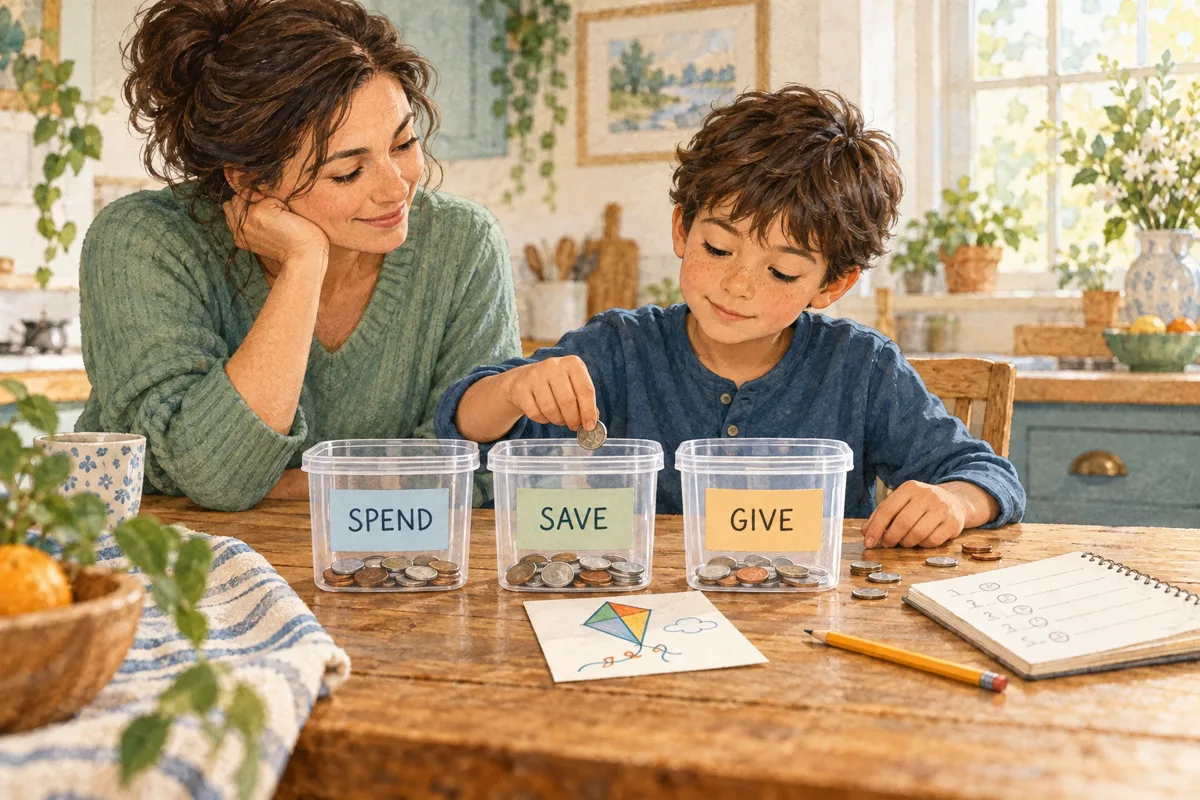
“Can I buy something now and still save for later?”
Three labeled containers give that question a place to land. One holds money for spending, one holds money for a future goal, and one holds money set aside for giving. Your child can see the choices, move the money, and explain the plan.
You do not need a new allowance system or a special set of jars. This standalone family activity works with a small amount of money your child already has—or with clearly labeled pretend money for practice.
What do Spend, Save, and Give mean?
- Spend: money available for a current, optional choice, within the boundaries you agree on.
- Save: money kept for a later goal. Name or draw the goal so “later” has meaning.
- Give: money set aside to help a person or cause your child cares about, with adult guidance.
The U.S. Mint offers a similar activity using containers labeled Spend, Save, and Share. Here, we use “Give” for the sharing category. The example amounts and family record below are original practice ideas, not recommended payment rates or required budget percentages.
Gather a few things you already have
- Three sturdy containers, envelopes, or small boxes
- Paper labels and a pencil or crayons
- A small amount of money available for this activity
- A sheet of paper for a simple record
Choose unbreakable containers if that suits your home. Keep coins and small objects away from children who may put them in their mouths; a grown-up can handle the cash while the child points or draws. For a cash-free version, draw three boxes on paper and write the amounts in them.
Set up the three jars together
- Label the containers. Write Spend, Save, and Give. Add a drawing if it helps: a shopping bag, a goal picture, and helping hands.
- Count what is actually available. Use money already received and available for the exercise. Leave expected gifts or possible future earnings out of today’s total.
- Explain the boundaries. Say what the spending money can cover. Keep essential food, clothing, care, and school needs outside this activity.
- Choose a purpose. Ask what your child might enjoy buying, what they would like to save toward, and whether there is someone or something they want to support.
- Make a first allocation. Decide together how much goes in each container. Write it down and count the total again.
Try: “We have $10 to plan with. Every dollar can go in one place. What would you like this money to do?” Listen to the answer before suggesting a split.
A made-up $10 example
Imagine a child has $10 available for optional choices. After talking with a parent, they choose $4 for Spend, $5 for Save, and $1 for Give.
| Jar | Amount | Purpose in this example |
|---|---|---|
| Spend | $4 | Available for an optional purchase |
| Save | $5 | Set aside toward a $15 craft-kit goal |
| Give | $1 | Reserved for a cause chosen with an adult |
| Total | $10 | Each dollar counted once |
With $5 saved toward the made-up $15 goal, $10 remains. That does not tell us when the goal will be reached; future contributions may vary. For a real purchase, check the current total price, including applicable sales tax and other required costs, together.
Now suppose the child spends $3 from Spend. The balances become $1 Spend, $5 Save, and $1 Give: $7 remains. The $3 purchase is recorded as money out, not money that is still in a jar.
How much should go in each jar?
For this activity, there is no required split. You can begin with whole dollars rather than percentages. Choose amounts that fit the money available, your family’s boundaries, and the child’s current goal.
If you agree on a standing rule, explain it before new money is divided. A planned split is easier to discuss than a surprise deduction after a child has already made a choice.
An empty jar is a conversation, not a verdict on your child. You can leave Give empty while you discuss possibilities, or save several small amounts before making a donation. Ask what the child understands about the choice instead of praising one jar as the “good” jar.
Keep giving concrete and voluntary within the activity
Ask: “Who or what would you like to help?” A grown-up can check an organization and handle any real donation. Explain what you can verify about how the money will be used, without promising an outcome you cannot confirm.
Your child may prefer to help through time or an action, such as making a kind note with you. Record that separately from the cash balances: an act of kindness does not add dollars to a jar. Avoid comparing siblings’ amounts or using the giving jar as a measure of generosity.
Use a record that takes one minute
Write the starting balances, then note money in, money out, or a transfer. If money moves between jars, it is still the same money.
For example, moving $1 from Spend to Save changes those two balances by minus $1 and plus $1. It does not increase the total. Count the physical money and compare it with the record when something looks confusing.
What if your child changes their mind?
Changing a goal gives you something useful to discuss. Ask: “What changed?” and “What would moving this money mean for your original plan?” Follow any boundaries you agreed on, and update the record together if you approve a transfer.
If your child wants to spend the Save money, work through the choice without calling it a failure. They might keep the original goal, choose a different one, or make a smaller purchase. Avoid silently replacing money that was spent or promising future payments to close the gap.
Can we do this without allowance or real cash?
Yes. Use available gift money if appropriate, or practice on paper with ten pretend dollars. Label pretend money clearly and explain that it cannot buy real items and is not a promise to exchange it for cash.
If you record real money that an adult holds elsewhere, make that clear too. A paper balance is a record of that money, not a second pile of money. You do not need to buy anything to have the conversation.
If you are deciding where money will come from, our allowance, paid projects, or both comparison covers that separate decision.
Finish with one short check-in
Ask your child to point to each jar and explain its purpose. Then choose one question: “What do you want to keep the same next time?” or “What was harder to decide than you expected?”
You can use the five-minute family money check-in when money comes in or a goal changes. Keep the focus on one manageable choice. The jars are a way to make a conversation visible, not a test to pass.
Sources for parents
- U.S. Mint: Spend, Save, or Share — a container-based activity for organizing money around goals.
- Consumer Financial Protection Bureau: Young children and saving — conversations about waiting and using a labeled saving container.
This article provides a family learning activity, not personalized financial advice. The sources do not endorse James Teen or prescribe the example allocation above.